

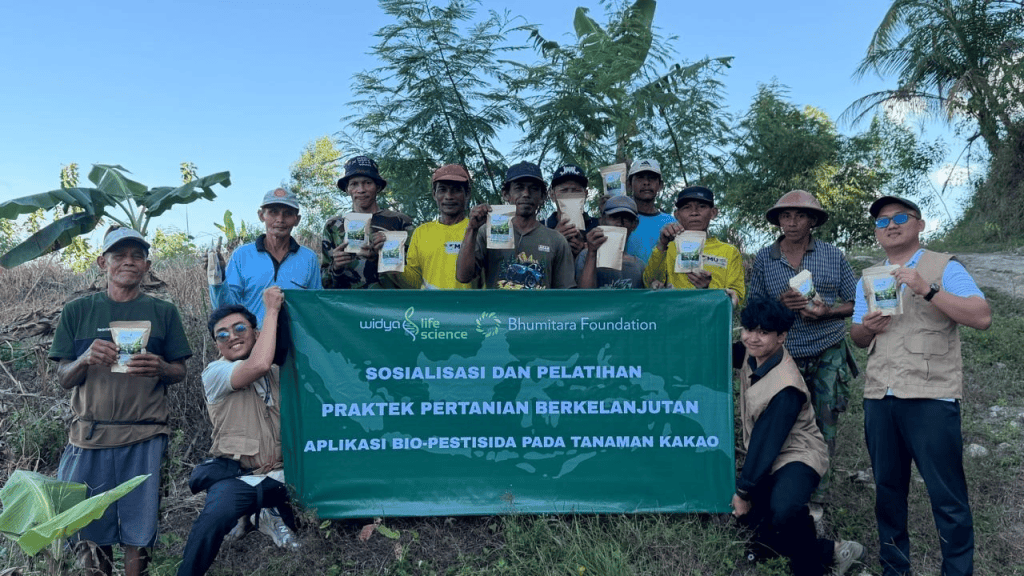
JAMBUSARI, CILACAP, 7 July 2026. Yayasan Bhumitara, together with Widya Life Science, held a training session on the demoplot of Kelompok Tani Kakao Desa Jambusari titled Sosialisasi dan Pelatihan Praktek Pertanian Berkelanjutan: Aplikasi Bio-Pestisida Trichoderma pada Tanaman Kakao. The program’s aim was direct: introduce cacao farmers to Trichoderma as a biological alternative to chemical fungicide, and walk them through the application itself rather than leave the practice as a leaflet handed out at the end of a meeting.
Thirteen farmers from the group attended, each leaving with a paper pouch of Trichoderma in hand. Widya Life Science supplied the product and the technical material behind it. Bhumitara organized the sosialisasi and led the field application. The demoplot itself belongs to the farmer group, not to either organization, and the training was built around trees the farmers already tend rather than a controlled plot set apart from their daily work.
That framing matters, because the real subject of the morning was smaller and harder to see than a banner or a training agenda: what a fungus does to another fungus once it is in the soil.
Trichoderma is not a new discovery. Its use against soil-borne cacao pathogens such as Phytophthora and Fusarium has been documented for decades. What made the training in Jambusari worth describing is not the science itself but the mechanism behind it, which most extension sessions skip and most farmers never see explained.
Trichoderma spores germinate near the root zone and grow toward pathogenic fungi, sensing them chemically before any contact is made. Once contact occurs, its hyphae coil around the pathogen’s hyphae in a process called mycoparasitism, releasing chitinase and glucanase enzymes that break down the pathogen’s cell wall from the outside in. A second mechanism, antibiosis, works in parallel: Trichoderma produces secondary metabolites that suppress pathogen growth directly. A third mechanism is simpler and easy to underestimate, competitive exclusion, in which Trichoderma colonizes root surfaces and consumes available nutrients faster than the pathogen can establish itself. A fourth mechanism operates inside the plant rather than around it. Colonization by Trichoderma primes the cacao tree’s own immune signaling, a process known as induced systemic resistance, so that the plant reacts faster and more strongly when a genuine pathogen attacks later.
Four mechanisms, one pouch. None of that was printed on the banner, and little of it made it into the field demonstration beyond a working explanation of how to apply the product without losing it to the first rain.
The demoplot belongs to the farmer group itself, not to an outside company, a detail that matters more than it might appear. Widya Teknologi Hayati (Widya Life Science) supplied the product for the training. Bhumitara ran the sosialisasi and the application session. But the land, the trees, and the decision to keep applying Trichoderma after the researchers leave belong to Kelompok Tani Kakao Desa Jambusari.
There is no yield comparison yet between treated and untreated trees on that plot, and it would be dishonest to write this as a success story before that data exists. What exists so far is a group of farmers who now understand, in mechanistic terms rather than marketing terms, why a fungus can defend a tree better than the fungicide they already know how to buy. Whether that understanding survives past this season is not something a single training day can answer.