












About Us
Bhumitara Foundation
SYMBOLIC MEANING
The 7 large leaves represent where we work, Indonesia and its diverse landscapes. Green leaves represent seven major geographical regions of Indonesia: Sumatra, Java, Kalimantan, Sulawesi, Papua, Maluku, and Bali & Nusa Tenggara. These seven regions symbolize Indonesia’s major island groups, each embracing and connecting the thousands of smaller islands that form the Indonesian archipelago, called NUSANTARA.
THE 7 LARGE LEAVES: INDONESIA’S SEVEN MAJOR GEOGRAPHICAL REGIONS
THE 7 SMALL LEAVES: HOW WE CREATE IMPACT
THE 7 SMALL LEAVES – HOW WE CREATE IMPACT
Protect nature
Create sustainable livelihoods
Empower communities
Preserve local wisdom
Build strong partnerships
Share knowledge
Create sustainable solutions
The visual arrangement creates a sense of movement, growth, connection, and resilience, reflecting Bhumitara Foundation’s commitment to creating positive change through collaboration between people, nature, and sustainable development.
The open center symbolizes a shared space for collaboration, knowledge, and collective action, while the outward movement of the leaves represents growth and impact spreading from local communities to wider ecosystems and regions.
ORGANIZATIONAL INTRODUCTION
The global ecological crisis—manifested through land degradation, exponential climate change, and the marginalization of rural economic structures—demands a fundamental paradigm shift in natural resource management. In response to this systemic urgency, the Bhumitara Foundation was established as a non-profit organization driven by a crucial mission to advance biodiversity conservation, regenerative agroforestry, inclusive rural development, and the empowerment of Indigenous communities throughout the Indonesian archipelago.
Our operational philosophy is deeply embedded in our nomenclature: “Bhumi” represents the element of earth or soil as the foundation of life, while “Tara”, extracted from the concept of Nusantara, symbolizes our institutional commitment to protecting the Indonesian archipelago’s landscape and celebrating its rich local cultural heritage.
We believe that resilient ecosystems and prosperous rural communities are absolutely interdependent. Through the implementation of Nature-Based Solutions, we redesign commodity farming systems to restore soil microbiomes, conserve forest canopy cover, sequester carbon, improve food security, and generate long-term economic circulation for smallholder farmers.
Our Vision & Mission
Vision
Healthy ecosystems, resilient communities, and prosperous rural landscapes where biodiversity, agroforestry, and customary knowledge shape a sustainable future.
Mission
- Protect and restore biodiversity through community-led conservation and regenerative landscape management.
- Promote agroforestry as a nature-based solution for climate resilience, carbon sequestration, food security, and sustainable livelihoods.
- Empower rural communities through capacity building, fair value chains, entrepreneurship, and inclusive economic development.
- Strengthen customary institutions by recognizing traditional knowledge and supporting community-led stewardship of natural resources.
- Build strategic partnerships to scale sustainable impact across Indonesia.
Our Core Value

Impact Zones
Targeting interventions in the most vulnerable terrestrial and coastal habitats to drive empirical change.

Local Talent, Real Leadership
Empowering indigenous wisdom and local pioneers for long-term transformation.

Data. Discovery. Results.
Utilizing cutting-edge science and transparent monitoring to replicate and scale impacts.

Integrity & Connection
Fostering cross-sector collaboration grounded in honesty and trust to unravel the complexities of ecological crises.

Sustainable Development Goals (SDG) Outcomes
Our operational framework is directly calibrated with the global development architecture, delivering empirical and precise contributions toward achieving the Sustainable Development Goals (SDGs):
SDG 1
(No Poverty)
SDG 2
(Zero Hunger)
SDG 5
(Gender Equality)
SDG 8
(Decent Work and Economic Growth)
SDG 13
(Climate Action)
SDG 15
(Life on Land)
SDG 16
(Peace, Justice, and Strong Institutions)
SDG 17
(Partnerships for the Goals)
Our 7 Strategic Pillars
To ensure our interventions yield long-term, measurable, and sustainable impacts, our transformation mechanism is built upon seven mutually reinforcing strategic pillars:
Biodiversity Conservation and Regenerative Agroforestry
Rural Economic Development and Equitable Value Chain Architecture
Evidence-Based Policy Advocacy and Epistemic Collaboration
Strengthening Indigenous Institutions and Mainstreaming Women's Leadership
Access to Finance and Economic Sustainability
Women's Issues and Empowerment Programs
Climate Resilience, Innovation and Sustainable Livelihoods
Why Partner With Us ?

High-Leverage Impact
A single initiative touches upon gender equality, climate resilience, and education simultaneously.

Community-Led Model
Women and youth are not just beneficiaries; they co-design and actively lead the projects.

Scalable & Replicable
Our scientific and community-based models are highly adaptable to other regions and agricultural commodities.

Aligned with Global Agendas
We directly advance Indonesia's commitments to the SDGs and National Determined Contributions (NDCs).
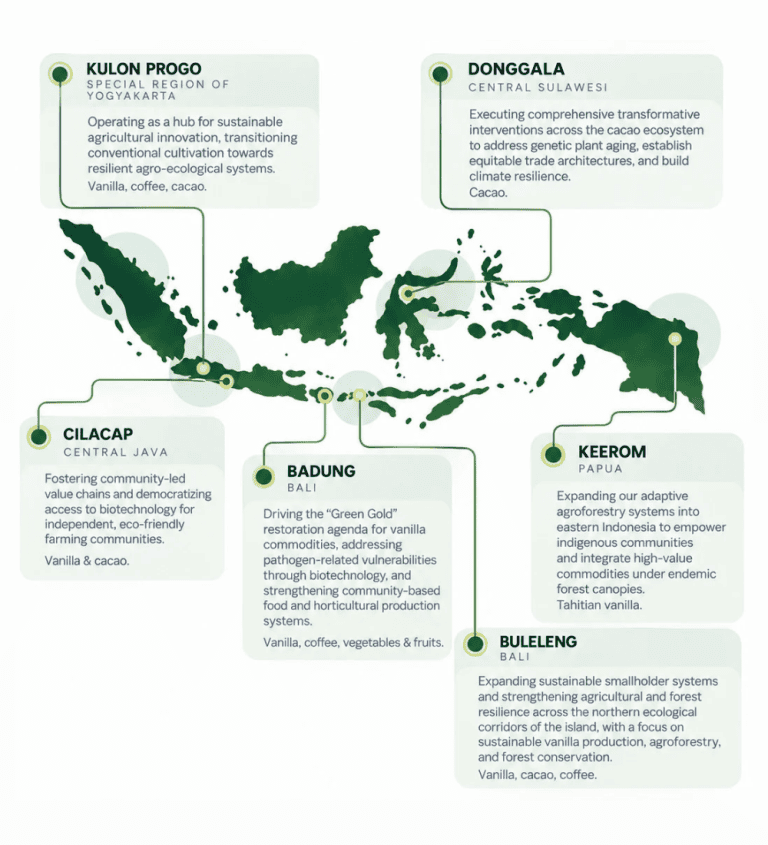
Where We Work?
To maximize efficacy and ensure sustainable empowerment, we adopt an asymmetric approach tailored to the unique agro-climatic, sociocultural, and administrative characteristics of each region. Our current and expanding intervention landscapes encompass critical ecological zones across Indonesia: